
Rhodes Piano Tuning: Stretch vs Equal Temperament
When tuning a Rhodes piano, players and technicians can choose between two systems: stretch tuning and equal temperament. Each approach brings out different qualities in the iconic electric piano and is suited to specific music contexts and tastes.
How we hear pitch is not uniform across the entire range of hearing. At lower frequencies, a note tuned exactly to equal temperament will often sound sharp. Similarly, in the upper frequencies, even an “exact” pitch may still sound flat to our ears. This is partly due to the logarithmic nature of human pitch perception and the vast frequency span found on instruments like the grand piano (spanning from about 40 Hz to over 4,000 Hz) .
Because of the wide range of a grand piano, almost all acoustic pianos are stretch tuned rather than locked to strict mathematical intervals. Professional piano tuners debate the best way to stretch tune, and some employ different curves to suit the specific instrument and musical preference. On digital instruments and synthesizers, stretch tuning may not be possible unless specifically supported or selected.
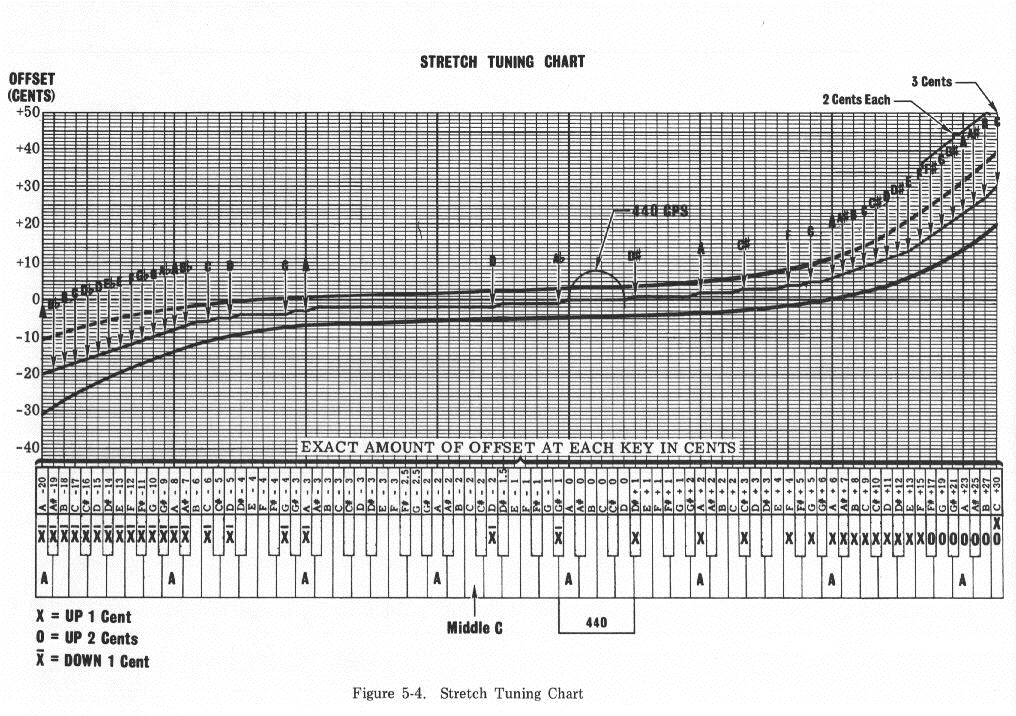
Rhodes pianos rolled out of the original factory in equal temperament but some of our clients describe that playing wide voicings on a stretch-tuned Rhodes feels more “accurate” and pleasing compared to equal temperament tuning, where they feel the high or low notes would often sound wrong.
What Is Rhodes Stretch Tuning?
Stretch tuning means tuning the highest notes a bit sharper and the lowest notes slightly flatter than equal temperament. This compensation for string inharmonicity results in octaves that sound “right” to human ears and creates a richer, livelier tone, especially when playing full chords or octaves.
- Produces a warmer, more resonant sound with enhanced clarity across the keyboard.
- Preferred by artists seeking a vintage feel and expressiveness for solo play.
- Requires a skilled technician and is less standardized than equal temperament tuning.
What Is Equal Temperament?
Equal temperament divides the octave into twelve equal steps, making all keys equally usable. This system is the standard for most contemporary instruments and is typical for Rhodes factory tuning.
- Provides consistent tuning across the keyboard, making it compatible in ensemble or studio settings.
- Enables seamless pitch matching with guitars, synths, and other digital instruments.
- Can sometimes sound less expressive (“sterile”) and dull in extreme registers, losing some acoustic warmth.
Pros and Cons
| Stretch Tuning | Equal Temperament | |
|---|---|---|
| Sound Quality | Livelier, richer, warmer | Standardized |
| Compatibility | Tricky with some digital instruments | Matches most studio/modern instruments |
| Ease of Tuning | Requires experience and skill | Widely used, straightforward |
| Factory Standard | Rarely factory standard | Default for Rhodes |
| Best Use Cases | Solo playing, vintage expressiveness | Recording, ensembles, pitch reference |
How To Choose a Tuning Method for Your Rhodes
For expressive solo performances and those seeking a classic, “acoustic” vibe, stretch tuning offers more warmth and musicality. For ensemble use, recording, or where pitch accuracy is critical, equal temperament is generally recommended.
Both systems can be used on the Rhodes, and many restorers experiment with hybrid or custom tuning depending on the player’s style, and musical context. We offer a hybrid custom tuning we call “Studio Tuning” which is a moderate version of the original factory stretch tuning.
Need help deciding which system is right for you? Contact us for expert service and advice.